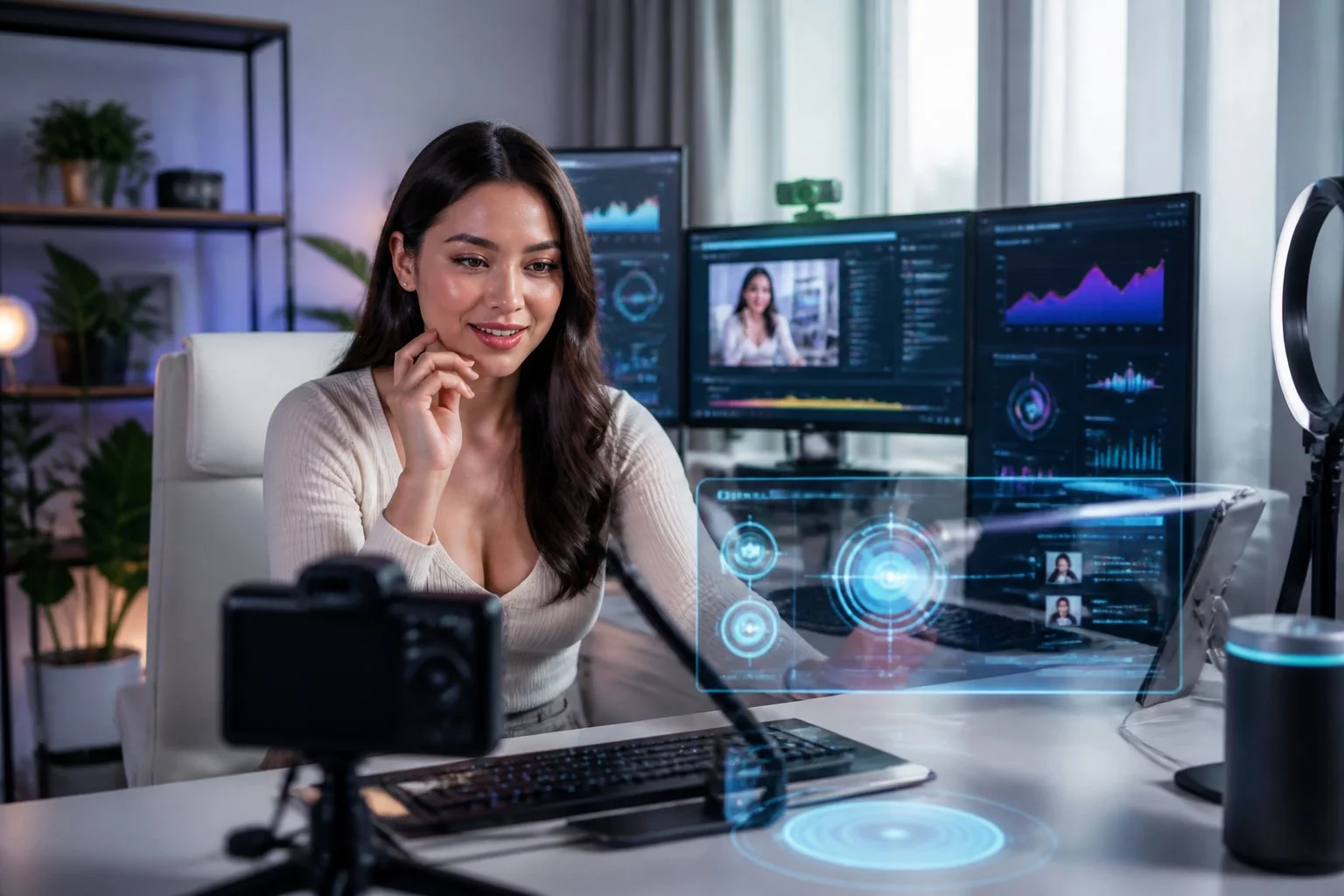
The Future of Camming: Tech Trends and Industry Insights
The Future of Camming: Verified Tech Trends | VRStrip.Cam
The Future of Camming: 7 VR, AI and Technology Trends Explained
What is the future of camming? Live adult webcam entertainment may continue to develop through virtual reality, artificial intelligence, mixed reality, better video streaming, connected devices and stronger privacy and age-assurance requirements.
But the existence of a technology does not mean every adult cam platform supports it, or that it will become widely adopted.
The short answer: Seven areas are worth watching: age assurance, VR video, mixed reality, streaming quality, interactive devices, AI-assisted production and performer privacy. Some are already established technologies or regulatory requirements. Their future use across adult webcam services remains uncertain.
For example, a headset with colour passthrough does not automatically support three-dimensional live performers. A camera advertised as 5K may transmit a lower-resolution live stream. And AI-generated video does not prove that human performers will be replaced.
This guide separates what exists today, what might develop next and which predictions lack convincing evidence. It also explains what adult performers and viewers should check before investing in equipment or relying on a new feature.
Editorial approach: We distinguish documented technical capabilities and published regulatory guidance from provider-specific features and speculative forecasts. We do not invent market figures, adoption rates or earnings projections.
VRStrip.Cam is an independent adult webcam affiliate directory, not a streaming platform or technology certification service. This guide is intended for adults aged 18 and over.
The Future of Camming at a Glance: Seven Trends
These developments are not equally mature. Some involve established hardware or regulatory requirements; others concern possible applications that need additional software, provider support or reliable evidence.
| Technology Trend | What Exists | What Is Still Uncertain |
|---|---|---|
| 1. Age assurance | Published UK requirements and Ofcom guidance | How each in-scope service implements its obligations |
| 2. VR cam streaming | Panoramic capture, stereoscopic formats and VR playback hardware | Availability and compatibility across individual live platforms |
| 3. Mixed reality | Headset passthrough and supported mixed-reality applications | Specific live cam integrations and realistic 3D performer presentation |
| 4. Video quality | Modern codecs, higher-resolution capture and adaptive delivery methods | Which live formats and quality levels each provider supports |
| 5. Interactive devices | Existing connected-device integrations on compatible services | Reliability, interoperability and wider adoption |
| 6. AI-assisted production | General-purpose creative and administrative AI tools | Provider policies, synthetic performer adoption and legal developments |
| 7. Privacy and content protection | Account security, reporting processes and applicable legal protections | Effectiveness against unauthorised copying and misuse |
Key distinction: A capability being technically possible is not proof that a particular cam platform offers it today.
How We Evaluate Future Camming Technology Claims
Claims about future technology should be supported by evidence appropriate to the claim being made.
A regulator can explain a legal requirement. A manufacturer can document hardware capabilities. A streaming provider can describe features on its own service. Independent testing may demonstrate how a specific implementation performs.
None of those sources, by itself, proves industry-wide adoption or future commercial success.
Our Evidence Categories
| Evidence Source | What It Can Support | What It Cannot Prove Alone |
|---|---|---|
| Regulatory guidance | Published requirements and regulator expectations | That every service complies |
| Manufacturer documentation | Device and software capabilities | Compatibility with every cam provider |
| Streaming provider documentation | Features offered or described by that provider | Industry-wide availability |
| Independent technical testing | Observed performance under stated conditions | Identical results across all devices and networks |
| Market forecasts | Predictions based on assumptions | Guaranteed adoption, revenue or timing |
| Individual testimonials | Personal experiences, where authentic | Typical earnings or universal outcomes |
Three Questions to Ask About Every New Feature
- Does it exist? Is there reliable documentation or a demonstrable implementation?
- Is it supported? Does the actual streaming platform, application or device provide the feature?
- Is the claimed benefit proven? Is there evidence that it improves quality, accessibility, safety or another stated outcome?
When only the first question can be answered, the feature may be technically possible without being practically available.
What We Do Not Treat as Established Facts
We do not treat unsupported predictions about AI replacing performers, VR becoming universal, guaranteed earnings increases or fixed adoption dates as verified conclusions.
Those claims require evidence that goes beyond promotional language.
1. Stronger Age Assurance and Online Safety Requirements
One of the clearest developments affecting UK adult online services is the regulatory framework for age assurance.
What Has Changed in the UK?
The UK's Online Safety Act framework includes highly effective age-assurance requirements for relevant services that publish or allow pornographic content.
Ofcom has published guidance on methods that can meet its criteria, depending on how they are implemented.
Potential approaches include facial age estimation, photo identification matching, certain credit card checks and digital identity services.
Simply asking a user to confirm that they are over 18 does not meet Ofcom's standard for highly effective age assurance.
For current requirements, see Ofcom's official online safety guidance.
What Does This Mean for Viewers?
UK users may encounter age-assurance processes before accessing adult content on services subject to the relevant requirements.
The process can vary by provider, and users should review how their information is handled.
What Does This Mean for Performers?
Performers should understand their hosting platform's verification, account-security and participation rules.
Viewer age assurance and performer identity verification are separate processes. A service's checks for viewers do not establish how it verifies the people appearing in broadcasts.
VRStrip.Cam does not independently perform age or identity verification on performers listed by third-party services.
What Could Develop Next?
Providers may continue changing their verification workflows in response to regulation, technology and operational requirements.
However, it would be misleading to predict one universal verification method across all adult services.
2. VR Camming and Immersive Live Video
Virtual reality is an established technology, but live adult webcam services differ in how they support immersive video.
Conventional 2D Webcam Streams
A conventional webcam stream generally displays a flat video image.
Watching that image inside a VR headset does not automatically turn it into stereoscopic or panoramic content.
VR180 Video
VR180 refers to video captured or presented across an approximately 180-degree field of view.
Compatible playback can allow viewers to look around the captured portion of a scene.
VR180 may be monoscopic or stereoscopic, depending on the content and capture system.
VR360 Video
VR360 offers panoramic viewing around the scene, subject to the capture and playback format.
As with VR180, panoramic coverage does not automatically guarantee stereoscopic depth.
Stereoscopic VR
Stereoscopic video presents different perspectives to each eye to support a sense of depth.
Its effectiveness depends on camera configuration, encoding, playback software and compatible hardware.
How the Formats Compare
| Format | Main Characteristic | Important Limitation |
|---|---|---|
| Conventional 2D | Flat video image | No inherent immersive depth or panoramic coverage |
| VR180 | Approximately 180-degree viewing coverage | Not automatically stereoscopic |
| VR360 | Panoramic viewing around the scene | Not automatically stereoscopic |
| Stereoscopic video | Different views for each eye | Requires compatible capture and playback |
Will VR Replace Traditional Webcam Shows?
There is no reliable basis for treating complete replacement as inevitable.
Conventional webcam viewing offers different equipment, bandwidth and accessibility requirements.
Immersive formats may continue to coexist with standard live video.
What Should Performers Check Before Investing?
- Does the hosting platform support the desired live format?
- Can the camera transmit that format live, rather than only record it?
- What software and connection hardware are required?
- Is the available upload bandwidth sufficient for the chosen settings?
- What additional areas of the room will the camera capture?
- Does the setup suit the performer's goals and boundaries?
For further information, read our guide to choosing a camera for VR streaming.
3. Mixed Reality and Passthrough Headsets
Mixed reality is a separate development from panoramic VR video.
It involves combining views of the physical environment with digital content through compatible hardware and applications.
What Is Passthrough?
Passthrough uses headset cameras to show the user's physical surroundings.
Compatible applications may display digital elements within that camera-based view.
What Does Meta Quest 3 Support?
Meta documents colour passthrough and mixed-reality capabilities for its Quest 3 headset.
These capabilities do not mean every adult webcam platform offers mixed-reality viewing.
Could a Live Performer Appear in a Viewer’s Room?
Different experiences are possible in principle, but they should not be confused.
A conventional video window displayed within a passthrough environment is not the same as a three-dimensional performer realistically positioned in the room.
Accurate volumetric presentation requires additional capture, processing and rendering capabilities.
What Is Volumetric Video?
Volumetric video aims to represent a subject in three-dimensional space rather than displaying only a conventional flat video image.
Implementations differ, and producing realistic live volumetric content may involve substantial technical requirements.
Should Performers Buy Mixed-Reality Equipment Now?
Not solely because a headset supports passthrough.
First confirm that the intended application offers the specific experience you want and understand any additional capture requirements.
Future possibility: More applications could explore mixed-reality presentation. That is not a guarantee of adoption by adult webcam platforms.
4. Better Streaming Quality, Compression and Compatibility
Video quality is influenced by the entire streaming workflow, not just the camera's advertised resolution.
Why a 5K Camera May Not Deliver a 5K Live Stream
A camera may support high-resolution recording while offering different limits for live output.
The hosting platform may also impose its own resolution, bitrate, codec or compatibility requirements.
Resolution, Bitrate and Compression
Resolution describes image dimensions.
Bitrate influences how much data is available to represent the video, while compression affects how efficiently that data is used.
Higher resolution does not automatically produce a better picture when bandwidth or encoding quality is insufficient.
Adaptive Bitrate Streaming
Some delivery systems support adaptive bitrate streaming, allowing compatible players to switch between available quality levels as playback conditions change.
Whether this is available depends on the provider and player.
Why Panoramic VR Can Look Softer
Panoramic video distributes image detail across a wider field of view.
Because viewers see only part of the scene at any moment, the apparent detail can be lower than expected from the overall resolution figure.
Will All Cam Shows Become 4K or 5K?
No universal resolution standard can be predicted reliably.
Platforms must balance video quality with bandwidth, latency, device compatibility and other practical requirements.
What Should Viewers Check?
Look for the provider's actual supported stream quality and compatible playback devices rather than relying on camera marketing terminology.
Read our 4K and 5K cam chat guide for a more detailed explanation.
5. Interactive Devices and Connected Cam Experiences
Some adult webcam services support integrations between compatible software, performer-controlled devices and authorised viewer interactions.
These features are separate from VR video itself.
How Do Connected Cam Devices Work?
Depending on the provider and hardware, supported platform events may trigger an authorised response from a connected device.
The exact interaction depends on software integration, permissions and device capabilities.
Does Every VR Cam Support Interactive Devices?
No.
A stream being VR-compatible does not guarantee support for a particular connected device.
Why Does Latency Matter?
Interactive responsiveness can be influenced by network conditions, platform processing, software communication and device connectivity.
There is no single upload-speed threshold that guarantees reliable performance across all integrations.
Consent and Performer Control
Performers should understand the available controls and manufacturer safety instructions before using connected equipment.
Viewer interaction or payment does not override performer consent.
What Might Change in Future?
Software integrations and device compatibility may continue developing, but no universal adoption rate or financial benefit can be assumed.
Browse our Lovense-related cam listings while checking the originating provider's current supported features.
6. Artificial Intelligence in Camming: Opportunities and Risks
AI is one of the most discussed technologies in predictions about adult entertainment.
However, AI-assisted administration, synthetic performers and unauthorised manipulation of real people's content are different subjects.
AI-Assisted Production and Administration
General-purpose AI tools may help performers with tasks such as:
- Organising schedules.
- Drafting accurate profile descriptions.
- Brainstorming permitted show themes.
- Preparing equipment checklists.
- Summarising authorised business records.
- Reviewing written promotional content.
These uses remain subject to platform rules, privacy considerations and the accuracy of generated outputs.
AI-Generated Performers
Synthetic imagery and video raise questions about authenticity, transparency, consent and platform eligibility.
Do not assume that a service permits AI-generated performer accounts or synthetic live broadcasts simply because the technology exists.
Could AI Replace Human Cam Models?
There is no dependable universal prediction about whether, when or to what extent synthetic performers might replace human broadcasters.
Technical capability alone cannot establish viewer preferences, future regulation or commercial adoption.
Deepfakes and Unauthorised Impersonation
Using someone's likeness or recordings without permission can create serious privacy, consent and legal concerns.
Performers should familiarise themselves with their platform's reporting procedures and consider appropriate support if content is misused.
Can AI Tools Use Performer Content for Training?
The legal position depends on applicable intellectual property rights, privacy law, contracts, permissions and jurisdiction.
Not every use is automatically lawful, and not every use is automatically a copyright violation.
Review relevant terms and seek qualified legal advice where needed.
How to Use AI More Carefully
- Do not upload sensitive personal information unnecessarily.
- Check whether the platform permits the intended use.
- Review generated content for factual accuracy.
- Avoid impersonating real people.
- Respect content rights and consent.
- Do not present synthetic testimonials as genuine performer experiences.
Practical takeaway: AI may be useful for certain workflows without providing evidence that human camming is disappearing.
7. Performer Privacy, Security and Content Rights
As capture and editing tools develop, performers may need to pay greater attention to how their identities, recordings and account information are protected.
Secure Your Accounts
Use strong, unique passwords and enable two-step verification where available.
The UK National Cyber Security Centre
Check Your Camera's Full Field of View
Panoramic cameras can reveal areas that would remain outside a conventional webcam frame.
Inspect the complete captured scene for documents, photographs, reflections, location clues and other identifying details.
Understand Recording and Replay Policies
Recording permissions and replay features depend on the hosting platform's terms and available controls.
Disabling authorised recording does not guarantee that unauthorised copying is impossible.
Understand Content Rights
Copyright, licensing, platform agreements and applicable privacy laws may affect how content can be used or redistributed.
Do not assume that every platform grants identical rights or offers identical takedown procedures.
Know How to Report Misuse
If content is redistributed without permission, review the relevant platform's reporting process.
Preserve relevant evidence where safe and lawful, and consider professional advice when necessary.
For further information, read our cam performer rights and privacy guide.
Future of Camming: What's Real and What's Hype?
Some claims are supported by documented technology or regulation. Others remain speculative or are misleading when presented as universal truths.
| Claim | Assessment | Why |
|---|---|---|
| Relevant UK adult services face age-assurance requirements | Regulatory requirement | Ofcom publishes applicable guidance |
| Consumer headsets support mixed reality | Established hardware capability | Manufacturers document passthrough features |
| Every cam platform supports mixed-reality performers | Not established | Requires evidence from each provider |
| VR will replace conventional cam shows | Speculation | No dependable universal adoption forecast |
| Every performer needs 5K or 8K equipment | Unsupported generalisation | Requirements depend on actual live workflows |
| Interactive devices guarantee higher earnings | Not established | Financial outcomes vary |
| AI will replace human performers by a fixed date | Speculation | No reliable universal timeline |
| Higher resolution always means better video | Misleading | Bitrate, compression and playback also matter |
| A VR badge guarantees stereoscopic video | Incorrect as a universal claim | Actual formats vary |
| Private sessions are always exclusive | Incorrect as a universal claim | Some providers permit spectators |
| Recording controls prevent every unauthorised copy | Unsupported | External capture remains possible |
These assessments should be reviewed when credible new evidence becomes available.
What the Future of Camming Means for Performers
Performers do not need to adopt every new technology to work professionally or pursue their own goals.
The most useful approach is to evaluate each feature against actual needs, costs and risks.
Before Buying New VR Equipment
- Confirm the hosting platform's supported live formats.
- Check the camera's live output rather than recording specifications alone.
- Calculate the full cost of accessories, software and maintenance.
- Review upload connection requirements.
- Consider privacy risks from wider camera coverage.
- Avoid assuming a purchase will increase earnings.
Before Introducing AI Tools
- Review platform policies.
- Protect sensitive information.
- Check outputs for accuracy.
- Respect rights and permissions.
- Do not fabricate performer identities or testimonials.
Before Adding Interactive Features
- Confirm device and platform compatibility.
- Read safety instructions.
- Understand the available performer controls.
- Decide which interactions are acceptable.
- Check how to stop or disconnect the integration.
A Simple Technology-Adoption Decision
| Question | If the Answer Is No |
|---|---|
| Does the feature solve a real problem? | Reconsider whether it is needed |
| Is compatibility confirmed? | Research before purchasing |
| Can you afford the full cost? | Delay or choose a lower-cost option |
| Are privacy and consent risks acceptable? | Do not adopt it until concerns are addressed |
| Can you evaluate the results? | Define what successful use would mean first |
New technology should support a performer's goals rather than determine them.
What the Future of Camming Means for Viewers
For viewers, new technology may offer additional ways to watch and interact with compatible broadcasts.
However, the available experience depends on the originating platform and individual stream.
Check the Actual Video Format
A VR label does not guarantee VR180, VR360 or stereoscopic playback.
Check Headset and Browser Compatibility
Not every service works with every headset, phone or browser.
Understand Paid Features
Tips, private sessions, interactive devices and recording permissions are determined by the provider's actual rules and features.
Understand Private-Show Visibility
Some services support spectator or spy-mode access during certain private sessions.
Do not assume that the word "private" guarantees exclusivity.
Respect Performer Boundaries
New technology does not change the importance of consent and respectful interaction.
For more information, see our VR cam beginner's guide and private cam shows guide.
Checklist: How to Evaluate a New Camming Technology
Use this checklist when you encounter a product announcement, provider feature or prediction about the future of camming.
| Question | Why It Matters |
|---|---|
| Is the feature available now? | Separates released technology from concepts |
| Who documents the claim? | Identifies the original evidence |
| Does the actual platform support it? | Avoids assuming universal compatibility |
| What hardware or software is required? | Clarifies the full setup |
| What does it cost? | Identifies the total financial commitment |
| What personal information does it use? | Highlights privacy risks |
| What rights apply to content? | Identifies licensing and reuse considerations |
| Does the performer retain control? | Protects consent and boundaries |
| Are claimed financial benefits evidenced? | Avoids unsupported return-on-investment assumptions |
| Can it be tested before major investment? | Supports more informed decisions |
If a claim cannot be traced to reliable documentation, treat it as unverified until stronger evidence becomes available.
Frequently Asked Questions About the Future of Camming
What Is the Future of Camming?
Possible areas of development include VR, mixed reality, AI tools, video delivery, connected devices, online safety and performer privacy. The extent and timing of adoption remain uncertain.
Will VR Replace Traditional Webcam Shows?
There is no reliable basis for predicting complete replacement. Conventional and immersive formats may continue to coexist.
Are VR180 and VR360 the Same?
No. They describe different viewing coverage, and neither automatically guarantees stereoscopic depth.
Does a VR Badge Guarantee Stereoscopic Video?
No. Confirm the actual stream format with the originating provider.
What Is Mixed-Reality Camming?
It may involve displaying compatible live content in a mixed-reality environment. The experience depends on the application and supported hardware.
Can Meta Quest 3 Display Mixed-Reality Content?
Yes. Quest 3 has documented mixed-reality capabilities, but specific third-party cam integrations depend on the application.
Is a Video Window in Mixed Reality the Same as a 3D Performer?
No. A flat video window and volumetric three-dimensional presentation are different experiences.
Will All Cam Platforms Offer 4K or 5K Live Streams?
There is no universal guarantee. Resolution and playback quality depend on provider support, equipment and delivery systems.
What Is Adaptive Bitrate Streaming?
It allows compatible video players to switch between available quality levels based on playback conditions.
Are Interactive Devices Already Used in Camming?
Some platforms support compatible connected devices, but features and availability vary.
Do Interactive Devices Guarantee Higher Earnings?
No. There is no universal earnings guarantee associated with connected equipment.
Can AI Help Cam Models?
AI tools may assist with administrative and creative tasks, subject to privacy, accuracy and platform rules.
Will AI Replace Human Cam Performers?
No dependable universal prediction can establish whether or when replacement might occur.
Can AI-Generated Performers Appear on Cam Platforms?
Policies vary. A platform's acceptance of synthetic content must be checked rather than assumed.
Can Someone Use Performer Content to Train AI Without Permission?
Lawfulness depends on applicable rights, permissions, contracts and jurisdiction. Unauthorised reuse may raise legal concerns.
Do UK Adult Websites Need Age Assurance?
Services within the relevant scope of the Online Safety Act face highly effective age-assurance requirements. Consult Ofcom for current guidance.
Is Clicking an Over-18 Confirmation Enough?
Ofcom does not regard simple self-declaration as highly effective age assurance.
Does VRStrip.Cam Verify Every Performer?
No. The originating streaming providers are responsible for their applicable age and identity-verification processes.
Are Private Cam Shows Always Exclusive?
No. Some providers support spectator or spy-mode access.
Can Performers Prevent Every Recording?
No. Platform controls cannot guarantee that unauthorised capture is impossible.
Should Performers Buy New VR Equipment Immediately?
Not without confirming compatibility, total cost and whether the equipment addresses a genuine need.
How Can Viewers Check New Cam Features?
Review the originating provider's documentation, supported devices and actual room settings.
Does VRStrip.Cam Host Live Broadcasts?
No. VRStrip.Cam is an independent adult affiliate directory linking to third-party streaming platforms.
The Future of Camming Depends on Evidence, Not Hype
Virtual reality, mixed reality, AI, connected devices and better video technology may influence the development of adult webcam services.
But a documented capability is not proof of widespread adoption, and a prediction is not an established fact.
For performers, the most useful priorities are understanding platform compatibility, protecting privacy, respecting consent and evaluating equipment against real needs.
For viewers, the best approach is to check what each provider actually supports rather than assuming that every room offers the latest technology.
The future of camming is worth following, but technological possibilities should be separated from verified features and realistic expectations.
VRStrip.Cam is an independent adult webcam affiliate directory intended for adults aged 18 and over. We may earn commissions from qualifying referrals to third-party platforms. We do not host broadcasts, independently verify third-party performers or guarantee particular VR formats, AI capabilities, interactive features, earnings or recording controls. Technical capabilities and regulatory requirements may change. This guide provides general educational information rather than legal advice.
Ready to experience live VR cams?
Enter Live VRStrip.Cam Free