Live VR Lap Dance Shows Streaming Now
Browse live VR lap dance shows streaming in immersive 360° virtual reality right now. Every room below is a real performer, live on cam, ready to perform — put on your headset or watch in your browser.
What Is a VR Lap Dance?
A VR lap dance brings an up-close, personal lap dance into full 360° virtual reality — right in front of you, as close as it gets. Instead of watching from a distance, the VR lap dance puts the performer in your space in immersive 360°, so it feels like they're dancing just for you. Every VR lap dance is a live, real-time performance streaming now.
Getting a VR lap dance is completely free — no downloads, no software, no account needed just to watch. Performers go live around the clock, so there's always a VR lap dance available right now.
How to Get a VR Lap Dance
Starting a VR lap dance takes seconds. Pick a live room below, put on your headset, and the show loads straight into 360° VR in your browser — nothing to install. No headset? The VR lap dance also plays in any regular browser on desktop or mobile, so you can enjoy one even without a headset.
Best Headsets for a VR Lap Dance
The VR lap dance works on every major headset — Meta Quest 2, Quest 3, Valve Index, PICO and more. A standalone Quest 3 delivers the most immersive VR lap dance, playing 360° VR straight in the browser with no PC required.
Explore More VR Cam Categories
Want more? Browse all live VR cam categories, jump into the full live cam directory, or spin the VR cam roulette for a random live performer in virtual reality.
💡 Key Takeaways
- Watching a VR lap dance like a regular video clip kills the experience, bad seating and an uncalibrated headset are almost always the cause.
- Spatial presence is your brain's sense that the virtual space and your physical body occupy the same spot; the Haptic Gap is the disconnect between what your eyes see and what your body feels.
- Closing that gap depends on physical cues, seat height, hand placement, and spatial audio panning, not raw resolution.
- 180° content often outperforms 360° for close-proximity VR because it concentrates pixels and sound on the performer and removes conflicting signals from behind you.
- IPD calibration, room setup, and audio settings are the three levers that matter most for felt realism.
- Clear communication and respect for performer boundaries are essential etiquette for live sessions and improve the experience for both parties.
Don't Treat a VR Lap Dance Like a 3D Video
Picture the first minute of a VR lap dance: the clip loads, the performer appears close, and everything should feel immediate. Then the chair sits too low, the audio pulls slightly to one side, and eye contact lands at the wrong height. The scene may still look sharp, but the body never settles into it. That is why pressing play without preparing the space turns close-proximity VR into an ordinary headset video.
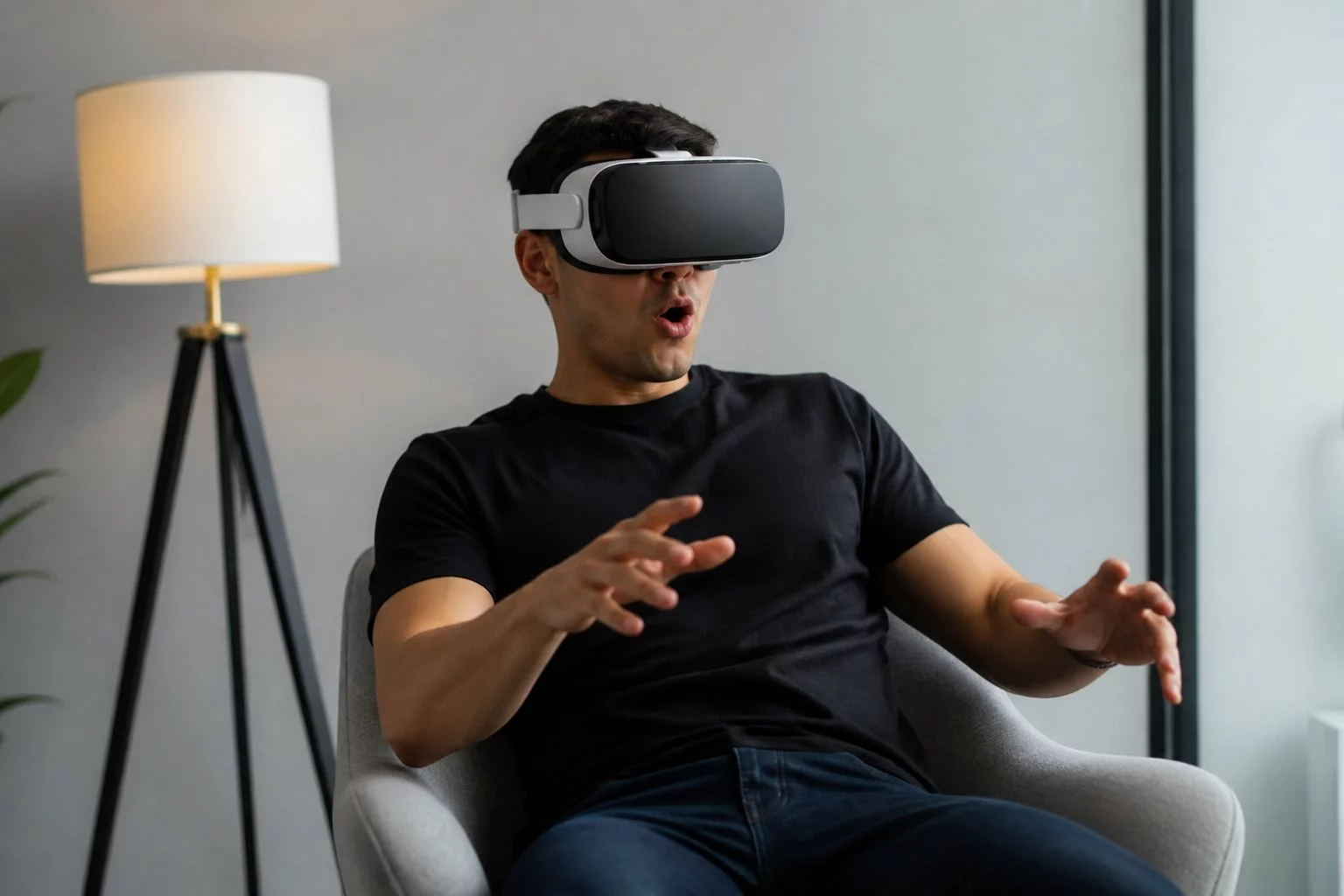
A VR lap dance is a close-proximity virtual-reality performance, live or pre-recorded, that simulates a lap dance using focused 180° or 360° video, spatial audio, and sometimes haptic feedback. The important word is not virtual. It is proximity. Close-range VR is unforgiving because your brain notices tiny mismatches that would not matter in a landscape video, a concert clip, or a game scene. If the performer appears close but your body does not feel positioned in the same space, the illusion collapses quickly.
A short calibration sequence, seat height, IPD, and spatial audio, usually closes the Haptic Gap and delivers noticeably better presence in under ten minutes. The fix is faster than many new users expect, and it is also more practical than most hardware advice. The strongest realism upgrade is often not buying something new. It is making the room, the chair, the headset, and the sound agree with what your eyes are seeing.
Spatial Presence and the Haptic Gap
Spatial presence is your brain's judgment that the virtual space and your physical body occupy the same spot. When it holds, the scene feels coherent. When it does not, everything looks staged, less like being in the room and more like peering through a window at it. That distinction matters because VR intimacy depends less on visual spectacle than on bodily agreement. Your eyes can be convinced for a moment, but your posture, balance, hands, and hearing get a vote too.
The Haptic Gap is what breaks that sense. It is the mismatch between what your eyes see and what your body actually feels. In a VR lap dance, the gap shows up in predictable ways: your eye line sits below the performer's gaze, your hands float instead of resting naturally on your thighs, and the audio bleeds in from the wrong direction. Any one of those pulls you out. All three together and you are essentially watching a video with a headset strapped to your face.
This becomes obvious once the performer is close enough for posture and gaze to matter. In a wide scenic video, a slight mismatch in scale may be ignored. In a VR lap dance, the performer is near enough that body position, gaze height, and sound direction become part of the performance. If the camera says someone is close but your body says the space is empty, the illusion does not fail dramatically. It just feels oddly flat.
A common detour is to fix this by chasing higher resolution or a better headset. That is rarely the actual problem. Calibration and seat alignment move the needle far more than pixel count. Presence improves when seat height, hand rest points, eye line, and audio all match what is on screen. Resolution can make a good setup look cleaner, but it will not rescue a setup that feels physically wrong. The bottleneck is not always image quality, it is agreement between the senses.
That also explains why 180° VR content often outperforms 360° for close-proximity sessions. The tighter frame keeps pixels and sound focused on the performer and eliminates the conflicting signals your brain picks up from behind you. A VR lap dance shot at 180° tends to hold attention better than a wider 360° recording, even when the wider format looks more impressive on paper. For this specific use, more space is not automatically more immersion. Sometimes the most convincing room is the one that stops showing you distractions you were never meant to use.
Setup: Calibrating for a VR Lap Dance
Begin with IPD and seat height. They affect felt realism more than resolution does, and many people skip them because they feel like setup chores rather than experience upgrades. For close-range VR, setup is part of the content. The chair is not just furniture, it is the physical anchor that tells your body where it is supposed to be.
- Choose your platform. Pick live platforms when interaction matters; use dedicated subscription services for recorded, high-bitrate 180° content. Live platforms prioritize responsiveness and eye contact but compress more heavily. Recorded subscriptions deliver higher bitrate, steadier cameras, and better lighting, all of which matter significantly for immersive VR lap dance content. The trade-off is simple: live feels socially present but may look less polished, while recorded content often looks cleaner but cannot react to you. Choose based on what you notice more, interaction gaps or visual flaws.
-
Room setup. Use a steady, armless chair where your shoulders can relax and your hands rest naturally on your thighs. A swiveling or soft lounge chair can feel comfortable at first, but it often introduces subtle movement that makes alignment drift. Where beginners struggle is assuming comfort alone is enough. For VR lap dances, stability matters as much as softness.
- Adjust chair height so your eye line meets the performer's eyes at their closest position. If the virtual horizon cuts through their chest, the chair is too low.
- Clear roughly 2 m (6 ft) around the chair so you're not clipping furniture if you shift during the session. The point is not to move around, it is to avoid the tiny moment of panic that happens when your knee or elbow hits something outside the scene.
-
Headset calibration. IPD calibration comes first. Poor IPD is the fastest route to eye strain, and the problem compounds over a long session. Re-check after the first ten minutes. Only disable the guardian boundary while fully seated, and re-enable it before standing. This feels like a small safety habit, but it prevents the exact kind of disoriented standing movement VR is worst at handling.
- Clean both lenses before starting. Even minor smudges reduce perceived sharpness and accelerate eye fatigue. Thirty seconds of cleaning makes an immediate difference, especially with skin tones, eye contact, and low-light scenes where haze is easy to mistake for bad video quality.
-
Audio and privacy. Use closed-back headphones or a sealed VR audio solution to prevent leakage. Set levels so the performer's breathing and spatial audio panning cues are clearly audible. If you share walls, test with a quiet clip and briefly step outside the room to confirm nothing bleeds through. Privacy is not only about avoiding embarrassment, it also lets you stop monitoring the real room and stay mentally inside the virtual one.
- Run a free 180° or 360° VR demo clip first to verify IPD, audio panning, and seat position before committing to a paid session. Most platforms include short demos for exactly this reason. If the demo feels wrong, a paid session will not magically fix the setup.
Plenty of first sessions go sideways because the IPD is miscalibrated and the chair is too low, not because the headset is obsolete. Get those two right before spending anything else. The better question is not, “What headset do I need?” It is, “Does my body believe the camera position?”
Real Examples and Scripts You Can Use
Live VR intimacy works best when requests are clear, limited, and easy to accept or decline. The mistake is trying to be either too vague or too demanding. Vague requests force the performer to guess what you mean, while overly specific demands can cross boundaries before consent is established. Good communication makes the session smoother because it removes negotiation from the most awkward moment.
Asking for a routine: "I'm looking for a slow, close lap dance in VR, are you comfortable doing a floor-to-knee routine and keeping eye contact with the camera?" Specificity paired with a non-presumptive tone speeds agreement and removes ambiguity. It also gives the performer a clean opportunity to modify the request, which is often what keeps a session relaxed rather than tense.
Setting limits: "I'll be muted this session; if you need me to adjust anything, tell me here." Performers prefer predictable signals. It respects their workflow and prevents awkward pauses mid-session. This matters more in VR than in flat video because delays feel larger when the performer appears close to you.
On haptic sync: "I have subtle haptics synced; I'll signal before I use them, does that work for you?" Advance notice keeps consent clear and timing clean. Haptics should never feel like a surprise the performer has to react to after the fact. Used well, they support the illusion. Used carelessly, they become another mismatch between expectation and control.
Stationary vs Pro Setups for Lap Dances in VR
Stationary users: Phone-based headsets and basic Bluetooth earbuds can deliver a convincing first VR lap dance experience. Focus on seating, IPD calibration, and audio rather than chasing higher bitrate right away. The realism jump comes from better calibration, not better hardware. Standalone and phone-based headsets often stream with heavier compression, so choose well-lit 180° content to preserve detail, that is where budget setups lose the most ground, and where a platform subscription with higher-quality encodes genuinely earns its cost.
Budget setups often fail in ways users misdiagnose. A soft image may be compression, but it may also be dirty lenses, low light, poor IPD, or sitting below the intended camera height. Stationary users benefit most when they treat the experience like a carefully staged seat position rather than a casual clip. They probably will not benefit as much from advanced haptics if audio, chair height, and content quality are still inconsistent.
Pro/PCVR users: PCVR unlocks higher bitrates, smoother frame rates, and haptic feedback integration. Haptic-synchronized devices narrow the gap between what you see and what you feel, but they require careful calibration and performer coordination. Subtle, well-timed haptic cues consistently outperform frequent, unsynced vibrations, a single well-placed vibration motor synced to audio cues typically does more for presence than a full multi-device rig running out of sync.
Pro setups reward patience more than spending. Driver conflicts, mismatched timing, Bluetooth lag, and overactive feedback can make a premium rig feel less convincing than a simple seated setup. This is where the setup decision becomes practical: adding devices adds sensation, but it also adds points of failure. The best pro setup is not the one with the most hardware. It is the one where nothing calls attention to itself.
If you cannot add physical feedback, seat vibration, hand placement, or haptic sync, upgrading to pro gear offers limited returns. Expensive hardware reads better on paper than it feels in use when the fundamentals are not dialed in first. Pro gear makes sense for regular users who already know what breaks immersion for them. It is less useful for beginners still figuring out whether the issue is content, comfort, calibration, or etiquette.
Common Mistakes That Kill Immersion
Leaving the guardian boundary active puts a visible grid across your field of view for the entire session. Disable it while seated, then re-enable it before you stand up. The grid is useful for safety, but in a seated close-proximity scene it can quietly turn the performance into a reminder that you are inside a device.
Wrong IPD and vertical alignment: Misaligned IPD makes faces look flat or warped and causes eye strain within minutes. If something looks off, pause and re-check calibration before continuing, do not push through discomfort hoping it settles. It will not. Many sessions fall apart here, not because of bad content or low bitrate, but because the headset was never properly dialed in to begin with.
Vertical alignment is just as unforgiving. If your chair is too low, the performer appears to loom from the wrong angle. If you are too high, the camera relationship feels off and eye contact loses its force. The first sign is usually not obvious discomfort, it is detachment. You find yourself analyzing the video instead of feeling present in it.
Poor live-session behavior: Moving in too close, triggering unannounced haptics, or shifting the camera unexpectedly breaks trust quickly. Predictable behavior is both respectful and practical. Performers value consistency, and clear consent keeps the session working for both sides. In live VR, etiquette is not separate from immersion. If either person feels uncertain, the scene becomes management rather than performance.
Social and Safety Etiquette for Live Sessions
Do not record or redistribute sessions without explicit performer consent, many platforms prohibit recording outright. If you share walls or live with others, confirm privacy first by testing sound leakage and room visibility. A realistic VR lap dance depends on attention, and attention disappears when you are worried about who can hear, see, or interrupt.
Consent comes before requests. Ask whether a performer is comfortable with a specific routine before describing it in detail, and assume no until they say yes. Vague or presumptuous requests blur professional boundaries and usually reduce the chance of a good outcome. Etiquette is not only moral housekeeping. It is also practical performance design. Clear limits let the performer focus on timing, camera distance, and eye contact instead of boundary enforcement.
Avoid off-platform contact, and follow posted tip menus or stated limits exactly as written. Keep camera and mic signals transparent, tell the performer when you will mute, unmute, or trigger haptics. That predictability prevents misunderstandings and respects their time. If a performer posts a stationary boundary or stated limit, treat it like a contract. A proximity VR lap dance session only works when both sides feel safe, and consistent respect for those limits keeps performers available for repeat bookings.
Use this decision rule before making a request: if it would be awkward to explain clearly before the session, it is probably too vague, too rushed, or too boundary-dependent to introduce mid-session. Good live VR is not built on surprise. It is built on consent, timing, and a shared understanding of what is supposed to happen next.
Cost vs. Benefit: When Subscriptions or Pro Gear Pay for Themselves
Free content works fine for testing seat height and IPD calibration. But low bitrate and weak spatial audio widen the Haptic Gap noticeably, and no amount of careful setup fixes that upstream problem. Even expensive rigs can feel flat when the content was not shot for 180° or 360° VR, worth checking before you spend anything. The content has to be designed for proximity, not merely converted into a headset-friendly format.
Users often over-prioritize resolution. Calibration and seat alignment usually move the needle more. A mid-tier platform subscription paired with one well-calibrated haptic device tends to be the sweet spot: fewer interruptions, higher bitrate, and performers experienced in close-range VR proximity direction. If you are booking regularly and care about consistent eye contact and minimal tech friction, a subscription upgrade tends to pay for itself within a handful of sessions, not because the technology is magic, but because the baseline quality stops working against you. Haptic accessories follow the same logic: one quality device used consistently outperforms two mediocre ones fighting for driver priority.
Who should spend? Regular viewers who already have their seating, IPD, audio, and privacy handled will notice the biggest improvement from better content sources or one reliable haptic accessory. Who should wait? Anyone still adjusting their chair every session, fighting eye strain, using leaky audio, or choosing content at random. Paying for higher quality before fixing the basics is like buying better speakers for a room that still echoes.
The realistic next step is not to build the most advanced VR lap dance setup possible. It is to remove the biggest source of disbelief. For some users, that means a better 180° subscription. For others, it means a stable chair, clean lenses, closed-back headphones, and a five-minute calibration routine. The useful takeaway is simple: realism in VR is not created by one impressive feature. It is created when nothing in the setup argues with the scene.
Frequently Asked Questions
What is the Haptic Gap in a VR lap dance?
The Haptic Gap is the disconnect between what your eyes see and what your body feels. It is most noticeable when your eye line sits below the performer's gaze, your hands appear to float in empty space, or the audio does not match the visual direction. Closing it requires matching physical cues, seat height, hand placement, and spatial audio, to what is happening on screen.
Why is 180° content often preferred over 360° for a VR lap dance?
180° VR puts all available pixels and spatial audio on the performer rather than spreading them around an empty room behind you. At the same bitrate, that concentration tends to produce stronger perceived eye contact and a more convincing sense of closeness than 360° footage typically delivers.
What are the most important setup steps for a realistic VR lap dance experience?
Start with IPD calibration and seat height, then check lenses, chair stability, and headphone isolation. A free 180° demo clip is the safest test because it reveals alignment problems before you commit to a paid session.
What etiquette should I follow during live VR intimacy sessions?
Ask for consent before requesting a specific routine, and be upfront about muting your mic, changing camera behavior, or activating haptic sync. If a performer posts limits, treat them as fixed rules rather than negotiation starters.
When does it make sense to invest in a subscription or pro gear for VR lap dances?
Upgrade after the basics are stable. Regular viewers with calibrated seating, clean audio, and reliable privacy will usually notice better content sources or one well-synced haptic device. If the fundamentals are still off, spending more will only make the flaws clearer.
Related VR Experiences
Lap dances play best as part of a longer night. Warm up with a live VR striptease show, then wander into the virtual VR strip club for stage rotations and lounge scenes. Want the widest choice of live models? Our VR Stripchat directory lists every performer online right now, and Quest owners should read the Meta Quest 3 VR cams guide so the picture matches the moment.